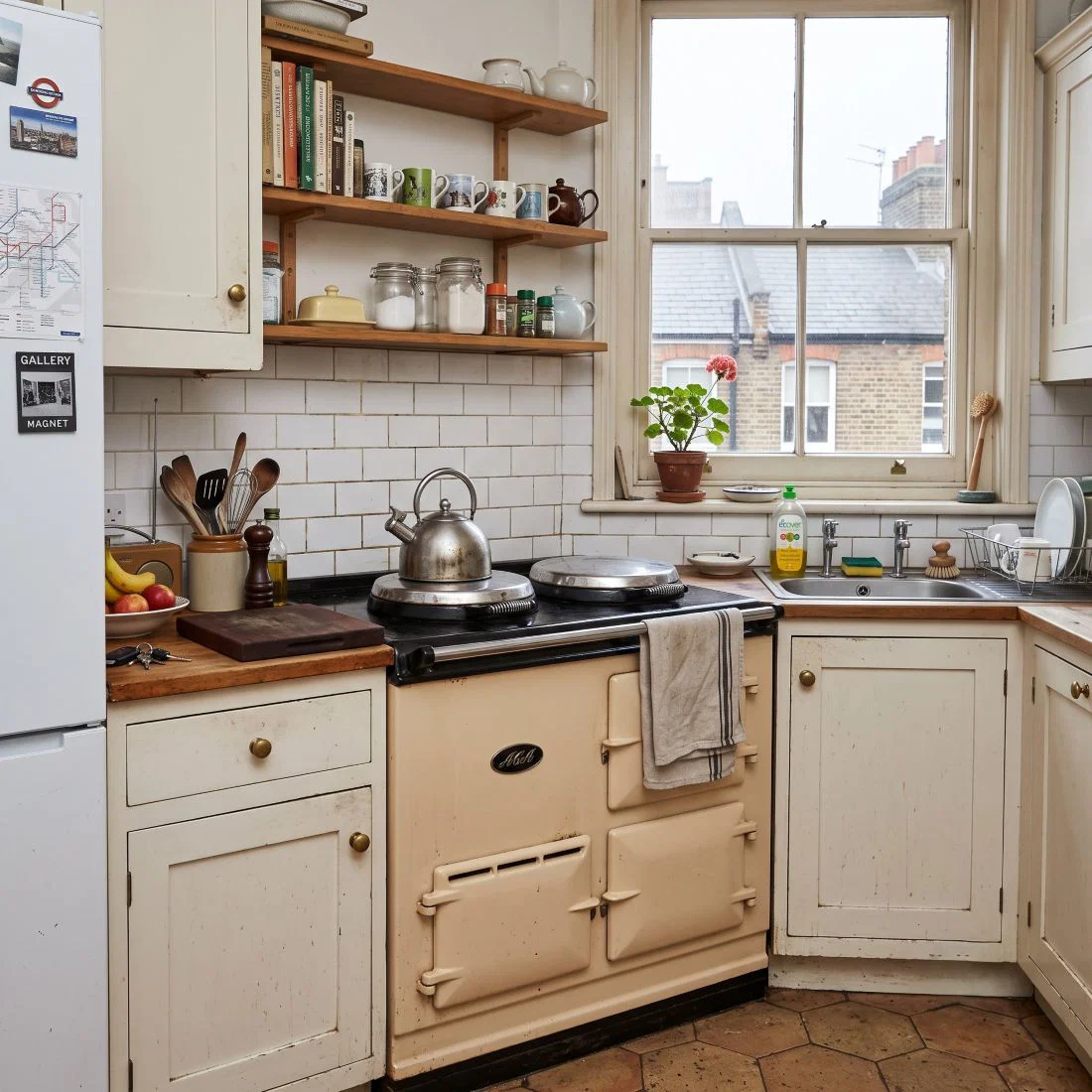
An Aga is not an oven with a bigger footprint. It’s a lump of cast iron weighing somewhere between a quarter and half a tonne, clad in glass, packed with insulation, and running continuously for decades in a room that was built before anyone thought about floor loading. Everything about cleaning one follows from that.
The trade treats it as a large domestic oven job. Six hours, dip the shelves, gel the cavities, wipe the front, invoice. I’ve been called out to repair the results of that approach more often than I’ve been called to do the work fresh.
What does caustic do to vitreous enamel, and why do Aga doors keep coming back dull?
Vitreous enamel is powdered glass fused to cast iron at around 800 degrees. It’s chemically tough, food-safe, and on a well-kept Aga it will outlive the person who bought it.
Its weakness is alkaline dwell. A short contact with a hot caustic solution does very little. Twenty minutes in a heated tank does something you can see under a raking light – a loss of depth in the gloss, a slightly chalky cast, most visible on the pale colours. Cream and pearl ashen show it worst. Pre-1980s enamel shows it worse still, because the formulations changed and the older stuff is softer.
The damage doesn’t announce itself on collection day. It shows up in the sun, three weeks later, when the customer notices the door no longer matches the body.
Then there’s the mechanical damage, which is more common and entirely avoidable. Enamel is glass, so any abrasive harder than it leaves micro-scratching, and micro-scratching holds soil. A door that’s been taken back with a green pad looks clean once and then dirties faster every single time after that, because you’ve given the surface a texture. Nylon, warm degreaser, patience. Leave it if it won’t come with that.
Chrome hotplate lids and the pad behind them
The hinged lids over the boiling and simmering plates are the component I most often see ruined.
They’re chrome over steel on the outside, with an insulating pad on the underside – on older units a felt or mineral wool disc held by a retaining plate. That pad is the reason the lid works at all, and it is absorbent. A lid that goes in a dip tank comes out with the pad saturated, which then takes days to dry, holds caustic against the inner face, and cooks off a smell every time you shut the lid for the next month. The chrome itself can lift at the seam.
There’s also the question of what the pad is made of. On units of a certain age it may be asbestos-containing, and anyone taking an old Aga apart without knowing what year they’re looking at is guessing with something they shouldn’t guess with.
Lids get cleaned on the machine, cold, by hand. Leave it.
Should you ever switch an Aga off for a deep clean?
I part company with most of the trade on this one, including some very good cleaners.
The standard approach is to shut the cooker down the night before, let it go cold, work on it dead the following day, and relight. It makes the job easier by a wide margin. Cold enamel takes gel without flashing off, you can get your hands inside the ovens, and the whole thing takes six hours instead of ten.
On a twelve-year-old electric or gas Aga in a house in Barnes, fine. Do that.
On a cast iron unit that has been running continuously since the late eighties, I’d think hard about it, and I frequently advise against it outright. Cast iron that has held a stable temperature for decades has settled. Take it from 200 degrees to ambient and back over forty-eight hours and you are asking a large, old, unevenly stressed casting to move, and things that have been quietly fine for twenty years choose that moment to stop being fine. Insulation slumps. Burner seals that were seated go. On oil models the vaporising burner needs recommissioning by a registered engineer and doesn’t always play along.
I’ve seen three units in fifteen years fail to come back properly after a cleaning shutdown. That’s not a large number. It’s a large number when the replacement conversation starts at five figures and the customer only wanted the oven doors doing.
Cast iron, thermal cycling and the twenty-year-old unit
So on old units I work hot, in stages, over two visits. Ovens get done at working temperature with the doors off, which is uncomfortable and slow and requires gloves that fit. Enamel fronts cold-cleaned. Shelves and tins go to the van and come back the same afternoon.
The customer gets a slightly less spectacular result and keeps a working cooker.
If a shutdown is unavoidable – a house move, a rewire, genuine neglect that can’t be reached hot – then it’s worth having the service engineer booked for the relight before anybody touches the cleaning. Not after. That ordering costs nothing and has saved me two very awkward phone calls.
What can a London period house physically accommodate?
This is the part that decides half of every job before I’ve opened a tin.
Aga installations in Victorian and Georgian London are almost always in the original chimney breast, in a recess that fits the cooker to within an inch or two on each side. There is no pulling it out. The sides never get cleaned properly on those units and anyone promising otherwise is describing a job they aren’t going to do.
Floor loading is the other constraint. A four-oven cast iron unit sitting on a suspended timber floor over a cellar in a Barnsbury terrace is a structural question, and it was answered – or not answered – by whoever installed it. What I notice is the symptom: doors that have stopped closing square, a visible slope on a spirit level across the top plate, a gap opening at the skirting. Worth reporting even though it isn’t my trade.
Damp is the quieter one. Solid-wall period kitchens with a cooker running warm against an external chimney breast move moisture around in ways nobody predicted, and I’ve found soft plaster and blown paint behind two Agas in the last three years, both in houses where the kitchen had been extended and the original ventilation blocked up.
Suspended floors, narrow halls and the flue you can’t move
Access matters more here than in any other kitchen work. Kit comes in through a hallway eighty centimetres wide with a return at the stairs. Dip tanks don’t fit down some basement kitchen stairs at all, which is why the tank stays in the van at the kerb and the shelves make the trip.
Flues bring their own trouble. A conventionally flued Aga in a conservation area is tied to the existing chimney, and a blocked or partially collapsed flue in an unlined Victorian stack shows up as sooting on the top plate and a cooker that won’t hold temperature. That’s a sweep and an engineer, not a cleaner. I say so, and I’ve had two customers in Dulwich Village annoyed with me for it, because they wanted the black marks gone and I wouldn’t just polish over a venting problem.
Where does the dip tank still earn its place?
Plenty of places. I’ve spent this piece listing what stays out of it, which gives a misleading impression.
Aga oven shelves, the grid shelves, the cold plain shelf, the large and small roasting tins, the half-size grill rack, the wire trivets: all of them go in, all of them come out properly clean, and none of them can realistically be done at the sink. The same applies to the ashpan and riddling grate on solid fuel models, which carry a hard clinker deposit that nothing domestic will shift.
The oven interiors are a different question and the answer surprises people. Aga’s own guidance is to let the roasting oven carbonise deposits and brush them out with a wire brush – the interiors are meant to carry a dark patina, and chasing them back to pale enamel with chemicals is doing harm for a cosmetic result nobody sees with the door shut. Brush it, vacuum the debris, close the door. Leave it.
Shelves, tins, and what changes on a modern range cooker
Rangemasters, Falcons, Stoves, the Italian and French kit – Lacanche, La Cornue, Bertazzoni – are a different animal, and most of them behave more like a large conventional cooker than an Aga.
Enamelled steel cavities take a standard non-caustic gel. Matt-black enamelled cast iron pan supports dip well and come back excellent, which is the single biggest visual improvement available on a gas range. Stainless trim, splashbacks and rails are straightforward.
The traps are small and specific. Brass burner caps discolour in caustic and are expensive to replace on Lacanche in particular. Aluminium burner bases dissolve, same as they do on a barbecue. Wok cradles with a bare cast iron ring want oiling after a dip. Catalytic liner panels, fitted to some Rangemaster and Falcon cavities, are ruined by any chemical at all – they’re a porous coating meant to oxidise grease at temperature, and gel clogs them permanently. They come out before anything else does. Some French enamel colours – the deep blues especially – are as susceptible to alkaline dulling as old Aga cream, and I hand-clean those doors regardless of what the tank could do faster.
Against my own interest, the honest position on an Aga is that it wants a light touch about twice a year and a proper deep clean far less often than it’s sold. Brush the ovens weekly, wipe the enamel when it’s warm rather than cold, keep water away from the hotplates and the insulation, and the cooker looks after itself for a long time.
A hundred-year-old design that survives on brushing and a damp cloth is a strange thing to sell an annual contract for.