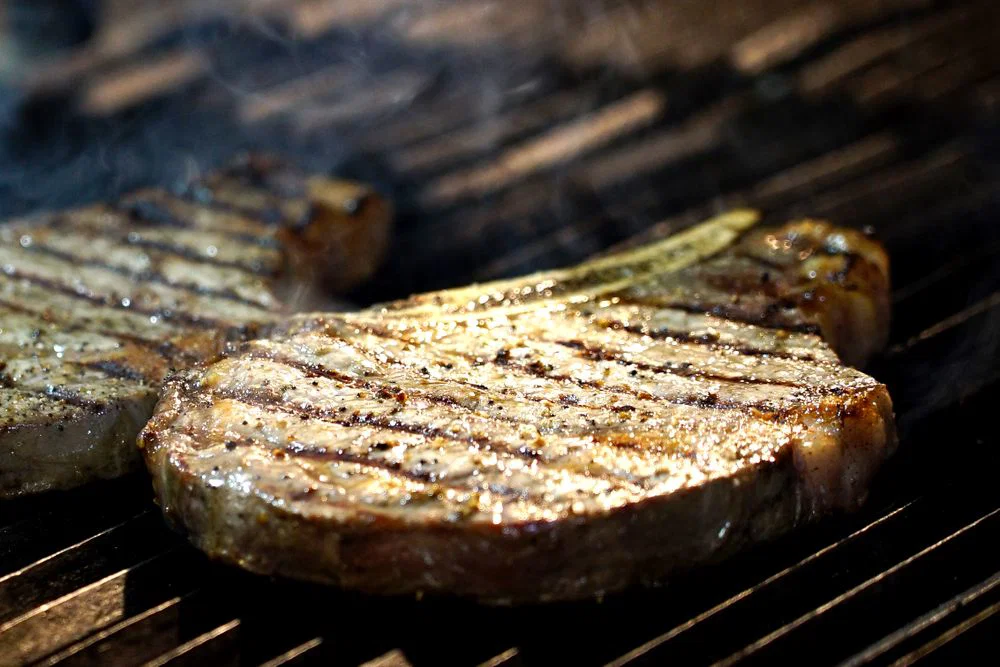
Why does a Josper foul an extraction system faster than a bank of ranges?
Because it burns solid fuel, and solid fuel produces a deposit that behaves nothing like the one every kitchen extract specification was written around.
A gas six-burner with a salamander over it throws vaporised fat into the canopy. That fat condenses on the filter bank, runs down into the collection channel, and what gets past the baffles carries on into the duct as a sticky amber film that thickens over months. It’s predictable. You can measure it, you can wipe it, you can put a number on it.
A charcoal oven throws that plus carbon. Fine particulate soot, some of it still warm, mixed with fat vapour and the resins that come off lumpwood and briquette. The black stuff sets hard. Within a few weeks the inside of a Josper flue in a busy service looks less like a greasy duct and more like the inside of a woodburner chimney, and it wants a different tool entirely – rotary brushes, a HEPA vac, and somebody prepared to work at the top of a vertical riser.
Then there’s volume. A Josper at 300-plus degrees with the door shut for twelve hours a day moves an enormous amount of fuel through a small chamber, and every kilo of that charcoal leaves something behind – ash in the drawer, carbon on the brick, and the rest of it up the flue.
Charcoal, fat and the two deposits that behave nothing alike
The mix matters more than either component. Pure soot is dry and brushes off. Pure grease is soft and dissolves. Combined, they form a layered, tarry crust that grips galvanised steel and refuses both approaches – you brush it and it smears, you gel it and the chemical sits on the surface without penetrating.
I spent a night on a system off Frith Street where the first three metres of horizontal run had a deposit you could get a screwdriver into. The restaurant had been cleaned quarterly by somebody, in the sense that money had changed hands quarterly. The canopy was spotless and the filters were newish. Past the plenum, nobody had been near it.
What does TR19 Grease require, and does it fit a charcoal system?
TR19 Grease has been the standalone BESA specification for fire risk management in kitchen extraction since 2019, sitting separately from TR19 Air, which covers general ventilation hygiene. It sets out that the whole system – canopy, filters, plenum, ductwork, riser, fan – is to be cleaned to a defined level, verified, documented and certificated. Technicians signing off the work should hold the BESA Grease Hygiene Technician qualification, and the clean gets registered so that a certificate exists as evidence.
The verification is where charcoal breaks it.
The accepted measure is wet film thickness. A technician takes readings at defined points and the system is regarded as clean below 200 microns. That test was designed for a fat film. It gives you a meaningful number on a gas range extract because the deposit is a film, and a film is what the gauge measures.
The 200 micron test and why it misreads soot
Run the same gauge over a Josper flue and you get a reading that means very little. Dry carbon doesn’t present as film thickness in any consistent way. You can take a WFT reading on a duct wall carrying four millimetres of hard carbon crust and get a number that looks compliant, because the crust isn’t wet and the gauge has nothing to bite on.
To be blunt about it: a contractor who hands a charcoal restaurant a post-clean report consisting of WFT readings and nothing else has produced a document for the insurer rather than an assessment of the building. The readings aren’t wrong. They’re answering a question about grease film in a duct whose fire load is carbon deposit, and the two aren’t the same problem. What that system needs is deposit depth recorded by direct measurement at access points, photographed, with the fuel type stated on the report. Some contractors do this. Most don’t, because the certificate doesn’t ask for it and the client doesn’t know to.
None of which is an argument against TR19 Grease. It’s the right framework, it’s what the Regulatory Reform (Fire Safety) Order 2005 duty gets evidenced against, and a restaurant without a current certificate is exposed on any fire claim. It just needs applying with a bit of thought about what’s burning.
Is the EHO looking at the same thing as your insurer?
No, and conflating the two costs restaurants money in both directions.
An Environmental Health Officer inspecting under the Food Safety and Hygiene (England) Regulations 2013 is scoring you on hygiene and food safety – structural condition, cleaning, and confidence in management. What they see is the front face of the canopy, the filter bank, the state of the grill itself, the ash handling, and whether the surfaces near the Josper are greasy enough to be a contamination risk. A filthy canopy face will hurt your rating. Carbon in a duct four metres above a suspended ceiling generally won’t, because it isn’t a food safety matter.
Your insurer is looking at the exact opposite. They don’t care whether the canopy face gleams. They care whether the riser is loaded.
Where food hygiene scoring and fire risk diverge
The practical upshot: you can hold a five and still be uninsurable in the event of a duct fire, and I’ve seen it. A place in Croydon with an immaculate front-of-house record and a well-run kitchen had never had the vertical section cleaned in four years of trading, because the access panel was behind a bulkhead the fit-out contractor had boarded over.
The reverse also happens. A restaurant in Battersea that spends heavily on quarterly TR19 work and lets the ash pan and the grill bars go for a week between deep cleans is going to lose points on an inspection while its certificate sits in a folder looking perfect. Both matter, and they need separate budgets and separate schedules, because the people doing them are doing different jobs.
How often should a London charcoal kitchen be cleaned?
TR19 Grease sets frequency by usage hours, and the standard bandings put heavy use – twelve-plus hours a day – at a three-monthly interval for the full system. That’s a floor for a charcoal kitchen, not a target. A Josper running from noon to midnight in a site doing 200 covers a night will justify a full system clean every two months, and the canopy and filter bank far more often than that.
The grill itself is daily. Grates scraped and brushed at close, ash pan emptied, the internal firebrick brushed down, glass door cleaned before the residue bakes on.
Weekly, the baffle filters come out and get dipped rather than rinsed, because a rinsed baffle looks clean and holds carbon in the folds. A baffle bank is the only thing standing between the black stuff and your ductwork, and half the sites I attend are running filters that were designed for grease alone on a system producing something else. Where a site has a dedicated charcoal canopy, it should have a spark arrestor section ahead of the baffles, and that section needs cleaning on the same cycle as the filters or it stops arresting anything.
Monthly, the canopy plenum behind the filters – the box the filters sit in – wants opening and washing down. It’s ten minutes of work and it’s skipped almost universally.
Access hatches, ceiling voids and the Soho basement problem
Frequency is theory. Access is the constraint that decides what really happens.
Central London kitchens are in basements with ducts that run horizontally under a pavement, turn vertically inside a light well, and terminate three storeys up on a flat roof shared with two other leaseholders. Access panels are supposed to be fitted at every change of direction and at intervals along straight runs. In an original fit-out done to DW/172, they generally are. In the third refit of a Charlotte Street site by a contractor working to a budget, they are not, and a section of duct becomes uncleanable without cutting steel and making good.
Roof access is the other one. A fan unit on a shared flat roof in a mixed-use block means a licence from the freeholder, sometimes a permit and a man-safe system, and a fair chance the residential leaseholders below will object to a two-hour clean at eleven at night. I’ve had jobs slip three months on that alone.
Have that surveyed before you sign a lease. A restaurant in Uxbridge I looked at last year had eleven metres of duct with a single hatch at the fan end, and the cost of retrofitting access ran to four figures before anyone cleaned anything.
What should a post-clean report contain?
A schematic of the system with each section marked as cleaned, partially cleaned or inaccessible. Before-and-after photographs at every access point, dated. Deposit measurements with the method stated. The technician’s qualification. A note of what couldn’t be reached and why, which is the section most contractors leave out and the section your insurer will ask about first.
The certificate that means something
Anything short of that is a receipt with a logo. I’ve inherited systems in Wembley and Dalston carrying paperwork that certified a clean nobody could have carried out, because the duct had no access beyond the plenum and the report didn’t mention it.
Now the part that costs me work. Most of what keeps a charcoal system safe isn’t a specialist clean at all – it’s the kitchen porter with a scraper and a wire brush doing twenty minutes at the end of every service on the grates, the ash pan and the inside of the canopy face. Sites that do that religiously need me less often and pay less when I come, because the black stuff never gets a chance to layer up. Sites that don’t will pay quarterly for years and still have a duct I can’t put a screwdriver through.
The brush costs about nine pounds.